OPBAS, the Office for the Professional Body Anti-Money Laundering Supervision, has recently published its 2024/2025 supervisory report which considers the effectiveness of anti-money laundering supervision by the Legal and Accountancy Professional Body Supervisors (PBS).
Simon Harbord, Teal’s Head of Consulting and Auditing, looks at the report’s main themes and gives a summary of his key takeaways.
Improvements noted, but concerns remain
The OPBAS report notes that ‘standards have improved, providing a strong foundation on which to build a new regulatory model’, however ‘PBSs report recurring common breaches by those they supervise’ and ‘some PBSs may still be taking an overly member-centric approach hindering robust supervision’.
Effectiveness ratings and key findings
OBPAS considered the effectiveness ratings of six PBSs and of the 48 possible outcomes (six PBSs x eight areas reviewed) only four out of the 48 were graded as effective.
The main finding was that OBPAS is ‘(not) assured that (the PBSs) are robust and effective on supervision and enforcement’ and ‘We’d expect PBSs to support the firms they supervise to comply with expectations. This should not, however, be disproportionate and come at the cost of holding members to account for material non-compliance’.
Light-touch supervision still evident
What this finding suggests in simple language is that many PBSs are still taking a light-touch approach, despite many warnings to be tougher. Of note, OBPAS hosted an international roundtable with representatives from seven countries to ‘exchange ideas, expertise and AML best practice’.
International comparisons and regulatory differences
At Teal, we not only audit and provide training and assistance to UK-based firms, but also those in many other jurisdictions, and our experience suggests the regulatory oversight requirements in some of them is far more robust (or you might say onerous) than here.
There is a considerable difference between the approach taken by the likes of the SRA/Law Society of Scotland and some foreign regulators, where the burden on firms is far greater. Possibly what the future holds for the UK?
Key issues identified by OPBAS
- Some PBSs have expressed varying views on the quality of third party provided AML software and outcomes achieved from its use. Let’s see if there is a Thematic Review coming?
Coincidentally the SRA has just published SRA | New guidance on using digital ID for money laundering checks | Solicitors Regulation Authority which is a must read.
- Some PBSs would benefit from further targeted guidance to their supervised population to address the continuing and unresolved problems with inadequate firm-wide risk assessments.
- PBSs continue to perform poorly in their enforcement approach.
- Some PBSs are overly relying on ‘assisted compliance’ to correct failures through a disproportionate focus on working with firms. This risks undermining the delivery of proportionate, effective and dissuasive disciplinary measures.
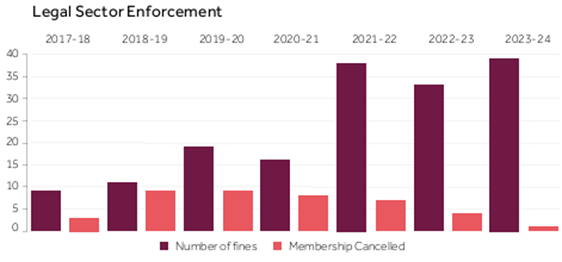
Enforcement data across the legal sector
The report also details the number of fines and membership cancellations across the legal sectors.
In conclusion
Overall, the OPBAS 2024/2025 report highlights that, while progress has been made, significant weaknesses remain in the consistency and robustness of supervision and enforcement across PBSs.
With increasing scrutiny and signals that a more stringent regulatory approach may be on the horizon, firms should take steps now to strengthen their AML frameworks, ensure compliance with evolving expectations, and be prepared for a potentially more demanding supervisory environment.
Get in touch
At Teal, we’re here to support your journey towards compliance that works.
We understand that compliance can be a daunting word, but it’s also the key to unlocking your firm’s full potential.
Our experts at Teal Compliance are here to help. Get in touch today to explore tailored solutions and ensure your firm stays ahead of regulatory requirements.